
Sources Behind Enterprise Neighbors
No single public roll names every person on an Enterprise block. The strongest Enterprise starting source is the parcel map because it fixes nearby land and assessed owners to visible polygons. A parcel is a unit of Enterprise land in the assessment system. Other Enterprise sources answer narrower questions, and each has its own access path.
| Source | Block Evidence | How to Access It |
|---|---|---|
| Coffee or Dale GIS map | Adjacent parcel shapes and assessed owner names | Free map browse and parcel click |
| Parcel card | Physical and mailing addresses, building and deed fields | Free county property portal |
| Probate deed index | Recorded parties for a selected parcel | Online account, office counter, or older books |
| Paid voter file | Selected registrant, address, district, and history fields | Statutory request and fee, with protected omissions |
| Planning packets | Public applicants and addresses tied to a city action | Published packet or narrow city request |
| Community organizations | Public officers and organizational contacts | Public directory or direct inquiry |
Enterprise ownership is not occupancy. An Enterprise parcel card may name an owner whose mailing address differs from the site's physical address. It does not enumerate renters, family members, or anyone else present. A careful neighbors lookup keeps the Enterprise record label attached to every name.
Map Enterprise Neighbors Parcel by Parcel
The documented Enterprise method uses ordinary map browsing. Coffee Public GIS has Map It and parcel zoom controls, but no authoritative Enterprise radius or buffer tool was verified. Start at one address, click only the touching or nearby polygons visible on the map, and repeat the Enterprise parcel-card review. Treat map geometry as an assessment reference, not a survey-grade boundary.
- Resolve the starting address in Coffee Public GIS. If it is absent near the eastern or southeastern city edge, try Dale Public GIS.
- Open Map It or Zoom Parcel. Note the parcels on each side and to the rear.
- Click each surrounding polygon and record its owner, situs address, mailing address, parcel key, and record date.
- Compare mailing and situs fields. A match may support owner occupancy, but it is not conclusive by itself.
- Use the deed pointer only when ownership history matters. For an entire road, switch to the Enterprise street directory.
This Enterprise flow stays local to the immediate block. It avoids turning a few adjacent-parcel checks into an unsupported claim about a whole Enterprise street.
Enterprise Neighbors Across County Lines
Enterprise crosses Coffee and Dale counties. Most parcels fall in Coffee, but southeastern and eastern sections may appear only in Dale's assessment system. A postal line reading Enterprise, Alabama does not settle the county. If the starting address or an adjacent parcel seems missing, the search may simply be on the other side of the records boundary.
The Enterprise fix is direct: compare the city-limit or county map, then run the physical address in both GIS systems when needed. Coffee parcel numbers use county prefix 19, while Dale's captured search uses prefix 26. Once found, keep later Enterprise deed and appraisal work in that parcel's county.
Note: Cross-county checks are especially important near the Dale fringe and Rucker Boulevard growth areas around Enterprise.
Enterprise Owners Are Not All Neighbors
An Enterprise county assessment record is built to describe taxable property. It can name the assessed owner, show where Enterprise tax mail goes, identify the physical site, and point to a deed. Those fields are valuable Enterprise block evidence, but they do not prove who sleeps at the address today.
Enterprise homestead or exemption information can sometimes support owner occupancy because Coffee rules require occupation by a deeded owner. Unexplained codes remain inconclusive. An Enterprise mailing address that matches the site is also a clue, not a household census. If the two addresses differ, do not assume the parcel is vacant or rented. The owner may have another correspondence address for many reasons.
- Assessed owner
- The person or entity shown on the county's tax roll for the parcel.
- Situs address
- The physical location assigned to the land or building.
- Mailing address
- The place where the assessor sends tax correspondence.
- Deed pointer
- The book, page, date, or instrument clue leading to the recorded ownership document.
Enterprise neighbors should therefore be described as assessed owners, registered voters, applicants, or public contacts according to the record actually consulted.
Enterprise Neighbor Records and Voters
Alabama VoterView verifies one voter through first name, last name, date of birth, and a CAPTCHA. It may confirm registration status, polling place, and registered address. It cannot browse an Enterprise block. A failed match may reflect spelling, date, inactivity, cancellation, protection, or no registration, so it never proves that someone does not live nearby.
Enterprise block-level work requires the paid statewide voter file under Alabama Code section 17-4-38. The request can select residence and mailing address, city, ward, precinct, council district, registration date, and election-participation fields when available. Electronic Enterprise data costs one cent per voter, and the requester submits the form before the state quotes the total. Election history shows participation, never a ballot choice.
Protected Enterprise officials and qualifying spouses can be removed from public lists. Domestic-violence court-address protections also apply in specific cases. Preserve the Enterprise file's as-of date, request only the fields needed, and never treat a blank field as a finding about the household.
Enterprise Community Contacts, Not Rosters
No official umbrella neighborhood association, HOA member directory, congregation roster, watch list, or club household roll was verified for Enterprise. That absence should remain visible. Private membership cannot be inferred merely because an organization serves the block.
| Community Source | Publicly Supported Information | Limit |
|---|---|---|
| Enterprise Chamber | More than 650 businesses and community organizations; 553 Glover Ave.; 334-347-0581 | Affiliations and public contacts, not households |
| Enterprise Public Library | Reference help at 101 E. Grubbs St.; 334-347-2636 | No verified reverse-directory or neighborhood-roster inventory |
| Enterprise planning records | Applicants and property addresses in public packets | Civic action evidence, not present occupancy |
Ask an Enterprise organization for its published public contact, not its private membership. The Enterprise Chamber directory can identify a business or civic role. The Enterprise library can help inspect local materials after a call to confirm holdings. Planning packets may connect a named applicant to an address and date, yet they still do not list all Enterprise neighbors.
Request Missing Enterprise Block Records
When an Enterprise record is not posted, the fallback is the office that keeps it. Enterprise permit or planning files can be requested from the relevant municipal custodian with a tight address and date range. Probate offices offer online access, in-person counters, and older Enterprise books or indexes. County appraisal staff can help locate an Enterprise parcel when the map search fails.
Alabama's reformed public-record process is set out in the current request statute. Requests generally require Alabama residency and must follow the custodian's written procedure. State the specific record, accept lawful redactions, set a fee limit, and ask for electronic delivery when practical.
The official Alabama request-statute page captured for Enterprise neighbors appears below.
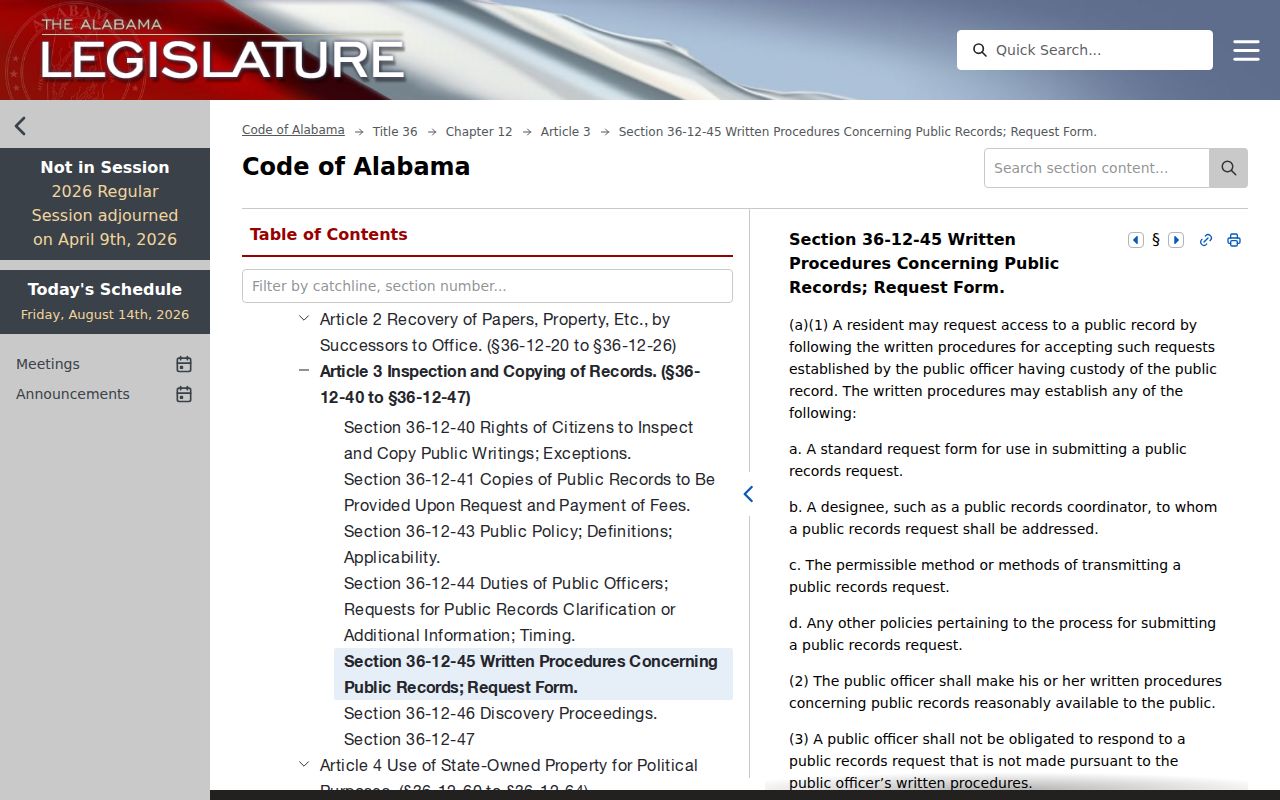
The law supplies a request route, not a right to private household data or an excuse to gather more personal information than needed.
Official Enterprise Neighbor Sources Compared
Commercial neighbor tools often blend stale addresses, public filings, and undisclosed sources. An official roll is narrower but easier to interpret because the custodian, field meaning, and update context are known. Neither type should be treated as a real-time household census.
| Question | Official Record | Commercial Compilation |
|---|---|---|
| Who owns the parcel? | County parcel card, dated and custodian-backed | May repeat an old owner without context |
| Who is registered nearby? | Voter channel, subject to eligibility and protection rules | Source and update date may be unclear |
| Who lives there now? | No complete official household roll | Cannot reliably prove current occupancy |
| How is an error fixed? | Correct the county, city, court, or voter source | Use the operator's opt-out after source correction |
For personal safety, use a purpose-built official source when one applies. The ALEA offender-registry gateway is separate from parcel browsing and warns against harassment. Its captured gateway appears below.
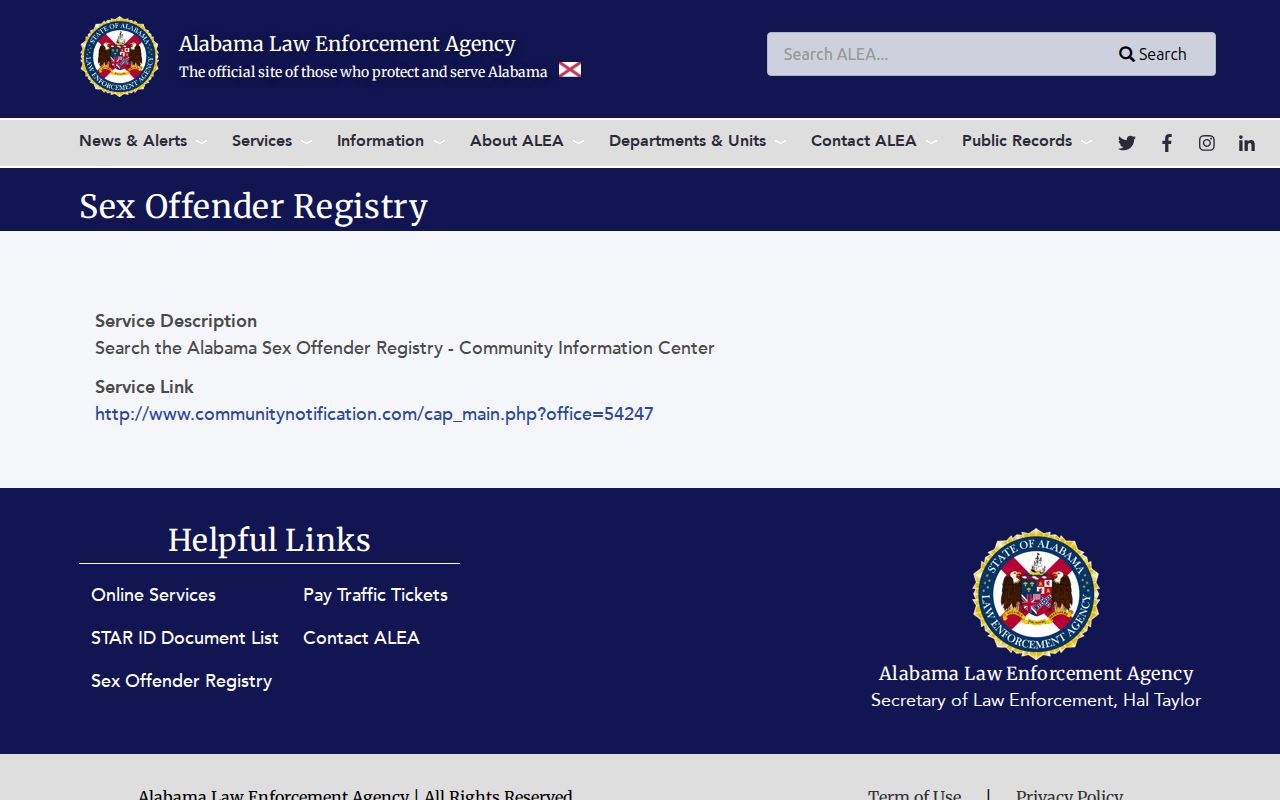
The registry supplements official community notice. It must not be used to threaten, harass, or draw claims beyond the record.
Privacy Limits for Enterprise Neighbors
Public block records stop well short of a household directory. Renters and family members may never appear. Utility and delivery customer data are not public neighbor lists. Driver addresses are generally closed by federal law. Protected voter entries and domestic-violence addresses may also be withheld, and court records can be sealed or redacted under governing rules.
Alabama law covers harassment and harassing communications, while the stalking statutes address an intentional course of conduct that causes substantial emotional distress. Public availability never authorizes surveillance, intimidation, identity theft, or attempts to bypass protected status. If a source is wrong, correct the custodian first. A commercial opt-out does not erase the official parcel, deed, voter, or court record.
Lawful use. Research Enterprise neighbors only for legitimate personal, civic, reconnecting, or safety needs. Never watch, threaten, harass, or expose a protected person.
Use the least personal data that answers the question. Save the source URL and access date, distinguish owners from occupants, and confirm any important fact with the office that maintains it.
Good block research stays narrow, dated, and tied to its source.