
Enterprise Directory Shelves and Screens
The firm spine for an Enterprise city directory search is the Alabama Department of Archives and History finding aid. Its LPR104 collection lists selected Enterprise editions in several boxes. The Library of Congress adds digitized telephone books, while federal census schedules and local research rooms supply the people and place context that a short directory line lacks. These sets overlap, but they are not interchangeable. In particular, the digitized white pages are telephone books, not proven household directories.
| Collection | Years represented | Where held | How to use it |
|---|---|---|---|
| ADAH Enterprise city directories | Selected editions, 1957 to 2000 | ADAH LPR104 boxes | Research-room access; gaps remain |
| Enterprise telephone books | Five runs, October 1946 to April 1987 | Library of Congress | Free digital subscriber listings |
| Federal census | Public schedules through 1950 | NARA, FamilySearch, ADAH | Household enumeration |
| Sanborn maps | 1905, 1910, 1929 | Library of Congress | Street and building context |
| Pea River research library | Collection-specific | 108 S. Main St. | Call-ahead local research |
ADAH lists 19 labeled editions or ranges representing 20 calendar years. That count is useful, but the finding aid does not name publishers or prove reverse sections. It also does not make 1957 the first book printed or 2000 the final one. Those are the endpoints of the documented holdings only. Ask staff about a specific year before planning a visit.
Enterprise City Directory Boxes at ADAH
The ADAH shelf breaks the Enterprise city directories among multiple boxes. Box 56 lists 1957, 1964, 1966, 1969, 1971, 1973, 1975, 1976, and 1978. Box 194 lists 1988, 1990, 1991–1992, and 1993. Box 129 holds an Enterprise–Ozark 1998 volume. Box 207 lists Enterprise 1997 and Enterprise–Ozark 2000. A range such as 1991–1992 may be one labeled edition, so count the citation as printed instead of inventing separate books.
The ADAH county records catalog is the next stop when a directory entry points to a deed, marriage, estate, or other county series. The catalog searches by county and one record type. Most original records still belong to the office that created them. The captured ADAH screen shows the county-and-record-type route researchers use to locate microfilm.
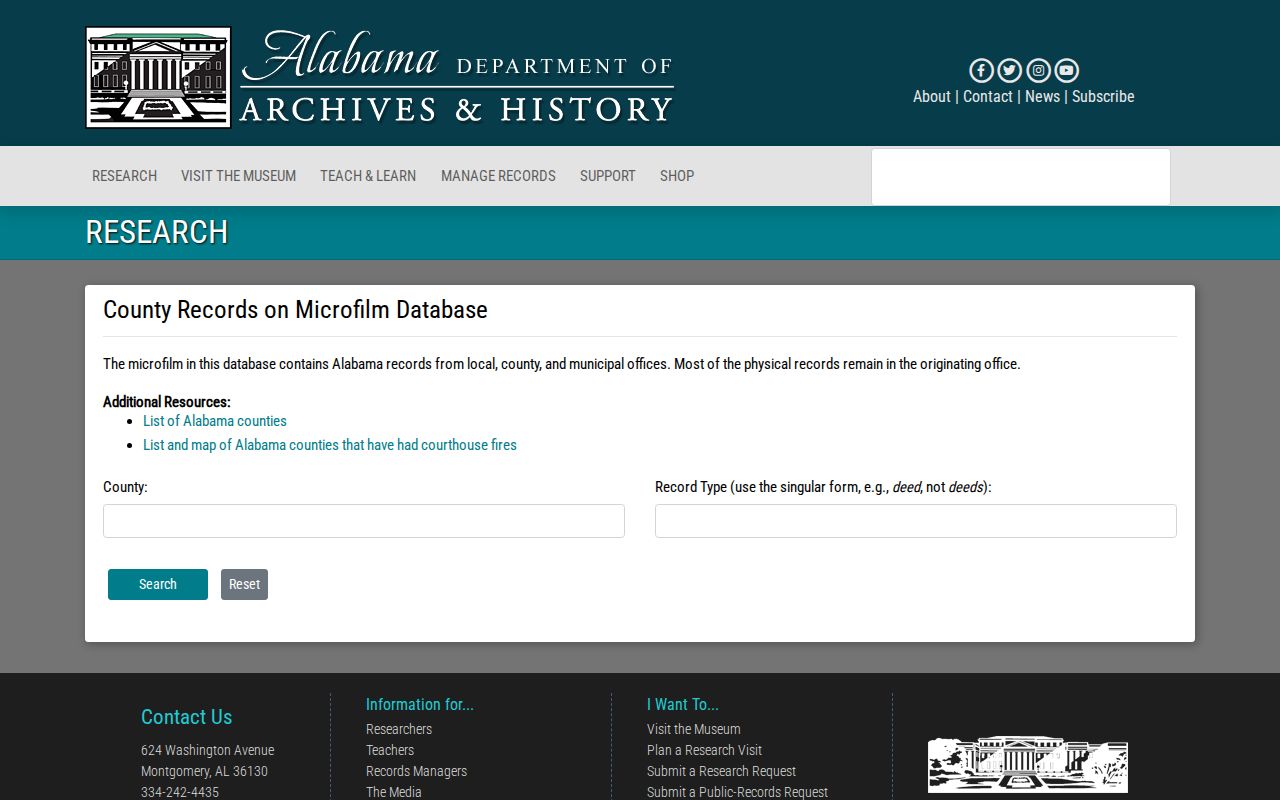
This catalog broadens a name found in an Enterprise volume without pretending that every county series is online.
Enterprise Telephone Books Online
The Library of Congress has five digitized runs covering October 1946 through July 1969, July 1970 through November 1974, November 1975 through November 1978, November 1979 through March 1984, and March 1985 through April 1987. These runs bridge many gaps in the selected ADAH volumes. A listed name, residence line, and phone number can place a subscriber at a dated address, but an unlisted person stays invisible.
Search the PDF for a surname, then browse nearby lines because scan text may miss old type or initials. Keep the volume date with every note. Telephone service, not residence alone, controlled inclusion. Military moves, omitted listings, shared phones, and spelling choices can all break a run. The strongest finding is a repeated address across adjacent editions, checked against another record.
Note: Treat the Library of Congress runs as telephone evidence, not proof that every person in an Enterprise home was listed.
Decode an Enterprise Directory Line
An inspected Enterprise telephone page arranges personal and business names alphabetically. Personal lines may include an honorific, the letter r, a house number, a directional or abbreviated street, and a phone number in the exchange style of its time. Ads and business lines appear among the names. The page does not show a universal spouse, occupation, employer, or owner-versus-renter field, so those details must not be added by assumption.
| Printed name | Personal or business listing, often alphabetized by surname |
|---|---|
| Honorific | Miss or Mrs. where the publisher chose to print it |
r marker | Introduces the listed residence address on inspected personal lines |
| Street line | House number, direction, and period street abbreviation |
| Telephone | Number in the exchange format used for that edition |
Photograph or save the title page and any key before copying entries. Symbols change by publisher and edition. The evidence here supports the r mark only for the inspected telephone page, not for every Enterprise city directory on the ADAH shelf.
- Criss-cross directory
- A section arranged by street or phone rather than surname. Confirm that a volume has one before relying on it.
- Householder index
- A name or address aid that points to listed household heads, not a census of all occupants.
- Abbreviation key
- The publisher's guide to short forms and symbols. Read the edition's own key before interpreting a mark.
Pair Enterprise Directories With 1950
The 1950 federal census is the latest public census under the 72-year rule. It sits close to the 1957 ADAH edition and within the Library of Congress telephone run. Begin with a household in the census, then test the surname and address in the telephone books leading toward 1957. A stable street can support continuity. A changed line may point to a move, a renumbered property, a death, or simply a new phone arrangement.
Census schedules name household members whom a telephone line may omit. The directory can then narrow the years between the ten-year federal snapshots. When a person vanishes, look for an obituary, probate estate, cemetery marker, or later affiliation. Enterprise City Cemetery has more than 2,000 markers transcribed by zone and alphabet through the Pea River society, with dates, inscriptions, photographs, and military notes.
Enterprise Research Behind the Depot
The Pea River Historical & Genealogical Society operates the Depot Museum at 106 Railroad St. Its Research Library and Gift Shop are behind it at 108 S. Main St. The society helps with family and local research and describes books, microfilm, newspaper files, old photographs, and area-family material. Posted hours are Monday 11 to 3, Tuesday through Friday 10 to 3, and Saturday 9 to noon. Call ahead because no authoritative online box-level inventory confirms directory or obituary coverage.
The Enterprise Public Library at 101 E. Grubbs St. offers a large general collection, public computers, and reference help, but its web page does not list directory years or newspaper microfilm. Enterprise State Community College adds WebCat, Alabama Virtual Library resources, EBSCOhost, JSTOR, and federal documents. Use those desks to identify a title, not to assume a volume exists.
Enterprise Maps Before the Directory Shelf
Three digitized Sanborn maps show Enterprise in July 1905, April 1910, and November 1929. They record building footprints, uses, street names, and numbers rather than residents. That makes them a bridge when an address changes or when a directory line points to a building that may no longer stand. Compare the correct sheet with a deed or directory citation before treating two street labels as the same place.
The maps matter because fire reshaped the record landscape. Much of the Enterprise business section burned in 1898, and the depot built in 1903 became a lasting landmark. Coffee County courthouse fires in 1851 and 1863 create an older caution. They do not prove every record series vanished. Ask Probate or ADAH about survival of the exact book needed.
| 1898 | Fire destroyed much of the Enterprise business section |
|---|---|
| 1903 | Depot construction supplied a durable address landmark |
| 1905, 1910, 1929 | Sanborn snapshots preserve street and building context |
| 1946 onward | Verified telephone-book runs begin documenting listed service |
| 1957 onward | Selected ADAH city-directory holdings begin |
Enterprise Records Between Editions
A directory gap can sometimes be narrowed with city records. Enterprise permit and planning files may identify an applicant, project, verified E-911 address, lot or block, and work dates. They date civic or property activity, not a whole household. Enterprise Citizen Self Service exposes business-license, permits-and-inspections, non-emergency-request, and utility-billing modules, but it requires a login and was not verified as an anonymous address search.
The Enterprise Citizen Self Service portal therefore serves as a signpost, with a narrow records request to the actual city custodian as fallback. Its captured screen confirms the module gate.
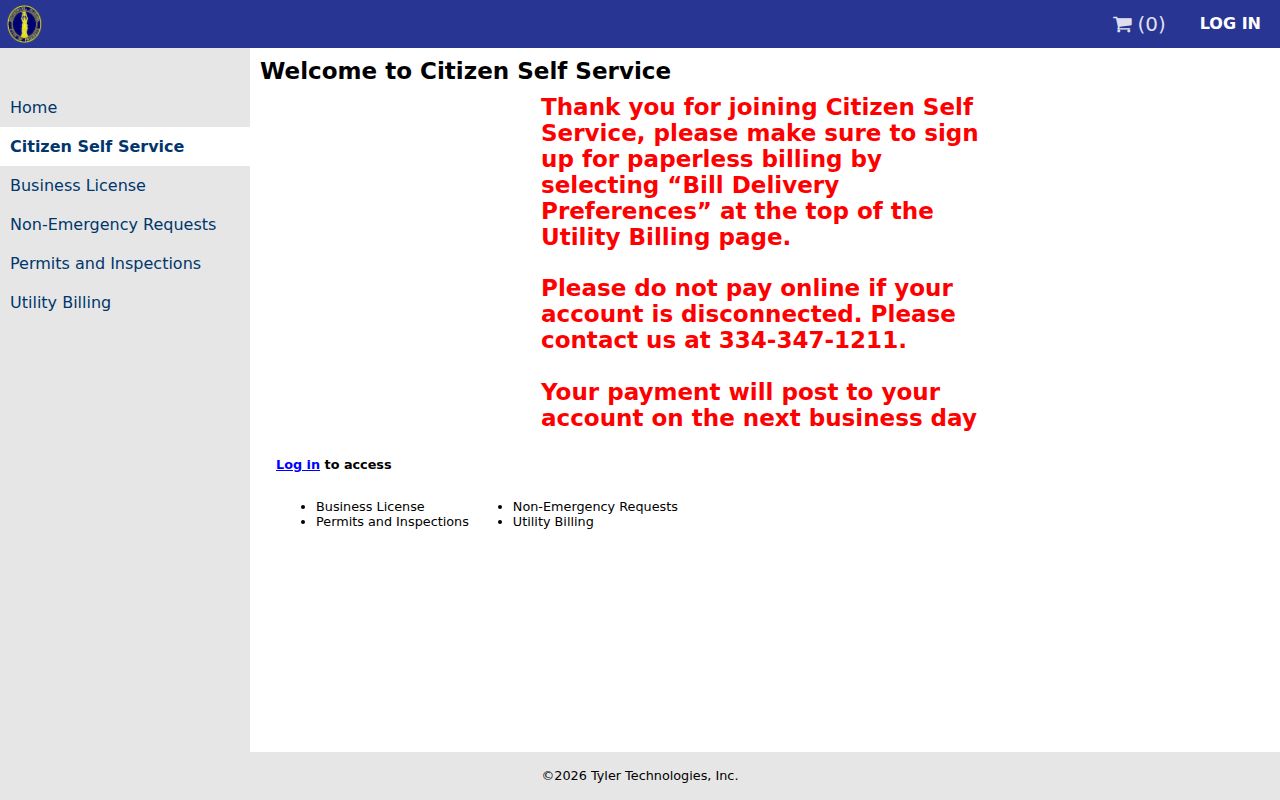
Ask for a named record series and date span. A login screen alone does not establish public fields, coverage years, or anonymous access.
Enterprise Names in a Changing City
Local events explain why a name or address may shift between books. Rail headquarters arrived in 1898. The boll weevil reached the area in 1915, and farming moved toward peanuts and more varied trade. Later, regional military aviation drove frequent moves along the Rucker Boulevard and Dale County fringe. A directory occupation or phone line belongs to that setting, but it cannot prove why one family moved.
Enterprise State's first class began in 1965 in rented downtown and church rooms, and the current campus opened in 1966. Those dates create a useful classmate trail through telephone books, local newspapers, and verified yearbooks. Search name variants and initials. Do not infer identity from a common name or guess a person's background from the form of a surname.
Trace Enterprise Families Across Editions
A sound Enterprise city directory trail keeps each source in its proper role. It starts with a dated line and builds outward. The aim is not to force a name through every book. It is to test whether independent records support the same person, street, and period.
- Copy the name exactly, including initials and honorifics, from one known edition. Save its date and title-page citation.
- Check the nearest earlier and later available editions. Record changes in spelling, phone, and residence rather than smoothing them out.
- Pair the line with the 1950 census when the dates fit. Use household members and ages to separate same-name residents.
- Use a Sanborn sheet for street and building context. Move to parcel and deed records only when the address needs a property link.
- Close a disappearance with probate, an obituary, cemetery material, or a later public affiliation. Absence alone never proves a move or death.
For a modern one-person check after a historical find, the Enterprise resident lookup applies current court, voter, business, and license safeguards. The city directory remains a dated historical source, not a live resident roll.